Turncoats and Rebels
The problem with Andy Burnham and the problem with Suella Braverman

As always, I am very grateful to you for reading The Debatable Land and more grateful still to those of you who have shared posts here with other people.
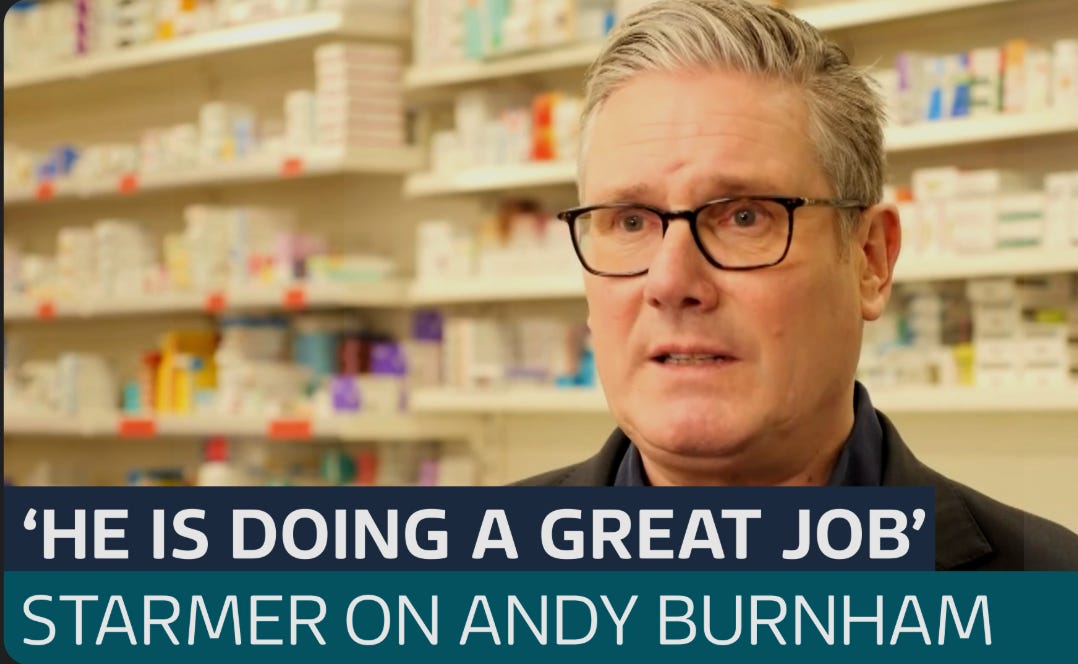
Two questions. First, why did Andy Burnham wish to return to the House of Commons? And, second, is a prime minister obliged to encourage or accommodate his would-be assassin? Answering the first provides the answer to the second. Andy Burnham wished to become an MP because he needs to be an MP if he wishes to lead the Labour party and serve as Prime Minister. This being so, it is surely obvious that Sir Keir Starmer was entirely right to block the mayor of Greater Manchester’s parliamentary ambitions.
Right in terms of his own self-interest, at any rate. You might argue that Burnham would be a better, more effective, Prime Minister than Starmer (I am not sure he would) but you cannot reasonably expect the current Prime Minister to agree with that analysis. So why should Starmer help Burnham challenge him?
Granted, there were no good or attractive options available. Preventing Burnham from standing as the Labour candidate in the Gorton & Denton by-election does indeed leave the Prime Minister looking weak. There’s a reason for that: he IS weak!
The downside is that even people previously unaware of this reality have a better understanding of it now. That weakens Starmer’s position a little more but, again, he was already weak and almost all the people who need to know that were already keenly, and sometimes painfully, aware of it.
Burnham, of course, made little attempt to disguise his ambition. What would be the point of doing so? Indeed, everything he has said since his non-selection confirms that he would never have been an honest or loyal “team player” returning to the Commons to “help” and “support” the government.
And since Burnham still believes we must “get over” the notion Britain is “in hock to the bond markets” (that is, to the people who lend the government the money it requires to function) I think we may reasonably conclude the wee king in the north is not half as credible or competent a politician as he thinks he is.
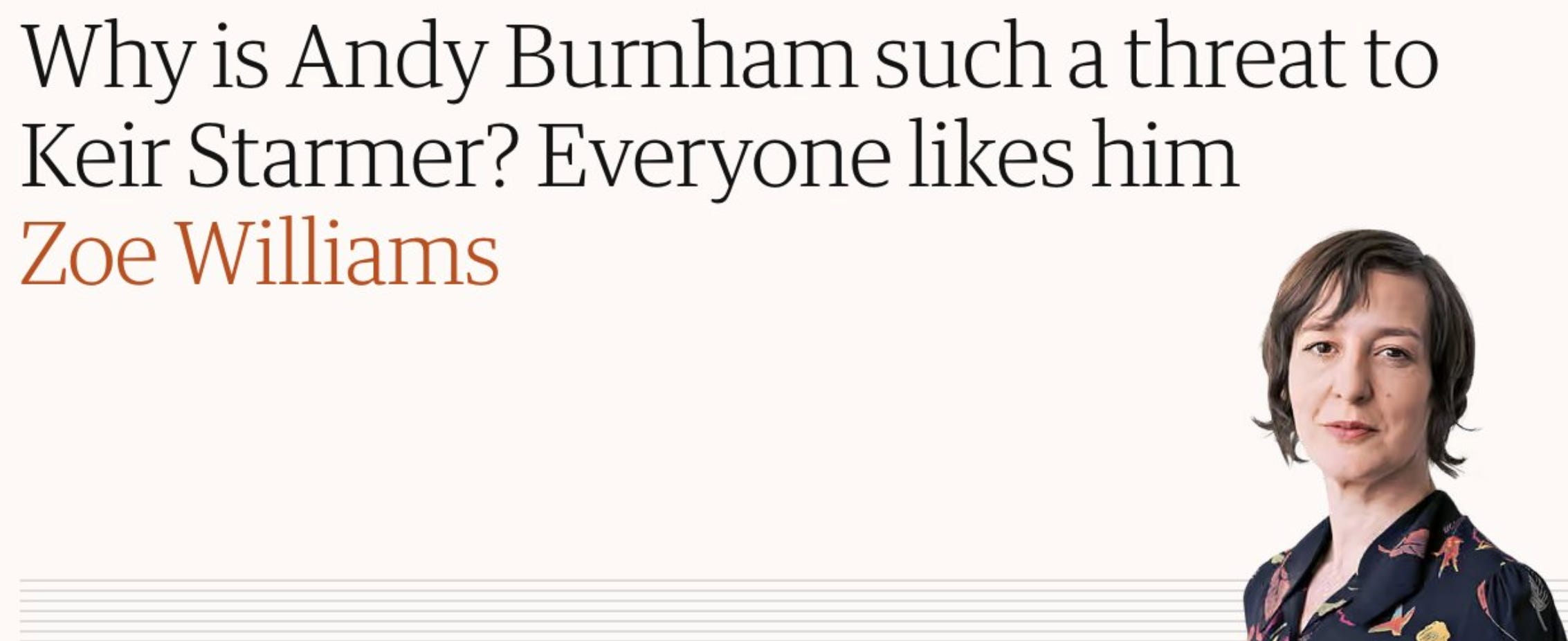
Indeed, Burnham’s appeal rests on his unavailability. As soon as he becomes available he also becomes less appealing. Because at that point he ceases being an idea and reverts to being Andy Burnham.
Labour MPs who want rid of Starmer are at liberty to complain about Burnham’s exclusion but they should recognise that they are asking the Prime Minister to abet his own political demise. What’s the upside of that for him? Just as Burnham was entitled to make his play, so was Starmer allowed his.
This temporary embarrassment, which may be compounded if Labour does lose the by-election, is still preferable (as far as the government is concerned) to the unending leadership drama that would follow Burnham’s election (assuming he won the by-election himself!). Everything would be put on hold until such time as the leadership question was settled.
And since too many things have already been put on hold for too long this would further concentrate the government’s difficulties. Chief of these is the Prime Minister’s disinclination, or inability, to set a clear path for his ministry and then - importantly - stick with it.
What is the government for? That is a harder question to answer than it should be and, after 18 months, I am afraid there are few grounds for thinking a proper answer will be found now. Successful governments know what they want to do and then find ways of getting to the place from which these things can be done. There is no evidence that Starmer grasps this.
But Burnham as an upgrade? Really? Come on.
Getting the Band Back Together
Meanwhile, over at Reform, the party’s desire to become a hardcore Conservative tribute act continues. After Nadhim Zahawi and Robert Jenrick and plenty of lesser lights comes good old Suella Braverman.
This is hardly a surprise, though one does increasingly wonder what’s in it for Nigel Farage. The country came to loath these politicians when they served in the last Conservative government and I consider it unlikely voters will warm to them now they sport the teal rosette of Reform.
Then again, what do I know? On social media there are plenty of Suella Truthers out there very happy to tell you that she’s very popular with the kinds of people tempted to vote Reform. Well, yes, so she is. But what of it?
This is a signalling mechanism and the signals it sends may not be those Reform think are being dispatched. I think adding discredited and unpopular ex-Tory politicians to Reform contradicts Reform’s key message. That message is: The Establishment Parties Have Failed And We Are Different.
The failure is plausible but it’s hard to argue for Reform’s difference when it becomes a kind of loopy facsimile of past Tory cabinets. This seems a risky ploy for Farage. Liz Truss may not be a member of Reform but we all know that if she votes at the next general election she’s more likely to vote Reform than Conservative.
I suspect that far from proving Reform is ready for government, this sort of thing confirms they are not. The more interesting question, however, is whether or not the people voting Reform actually want Farage to become Prime Minister. I am not sure they do. Or, to put it another way, it is easier to vote Reform if you think this is really just a protest vote than it is if you think Reform might actually win. If so, the closer Farage comes to Downing Street, the harder it will be for him to actually get there.
There is some precedent for this. In 2017, a vote for Jeremy Corbyn was seen as an essentially harmless act of protest. In 2019, a vote for Jeremy Corbyn carried the real risk he might somehow end up in Downing Street. This is the single simplest and most compelling explanation for why Labour did very well in 2017 and very badly in 2019.
Reform isn’t quite at that stage yet. But it may get there eventually. The sweet spot for Farage is for him to always be on the brink of being a credible Prime Minister without every actually quite being taken seriously as such by the electorate.
Meanwhile, in London…
This seems like a moment in which to note that, yes, when folk tell you who they are it might be sensible to take them at their word. This is Reform’s candidate for the mayoral election in the imperial capital.
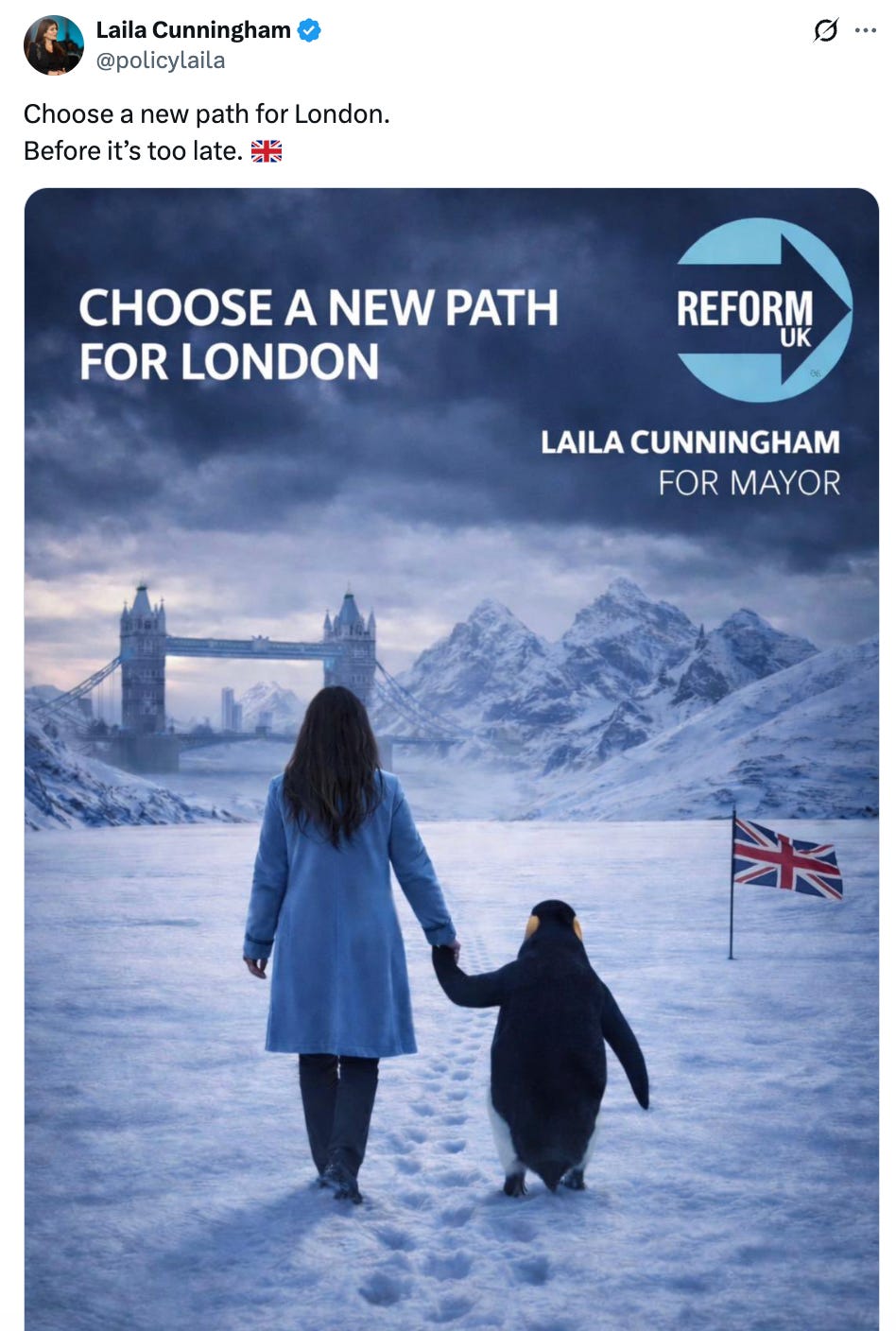
Social media is often all about trolling, of course, but it still seems worth noting that adopting, or aping, social media messaging first used by Donald Trump’s White House is, in the context of British politics, both bold and brave. There is certainly a Very Online British constituency for this sort of crap but I contend it is very limited and, furthermore, that many of Reform’s people are extremely high on their own supply of crypto-MAGA nonsense.
Again, Donald Trump is not popular in Britain (there, at last somebody has said it!) and associating yourself with him is a core vote thesis, not a “Let’s actually win an election that really counts” strategy.
Nevertheless, it tells you quite a lot that this is what Reform’s people think and most of what it tells you is not very good.
GC MAGA
There’s a lot of this stuff about, however. Here’s the Great Saviour of Women, Graham Linehan:
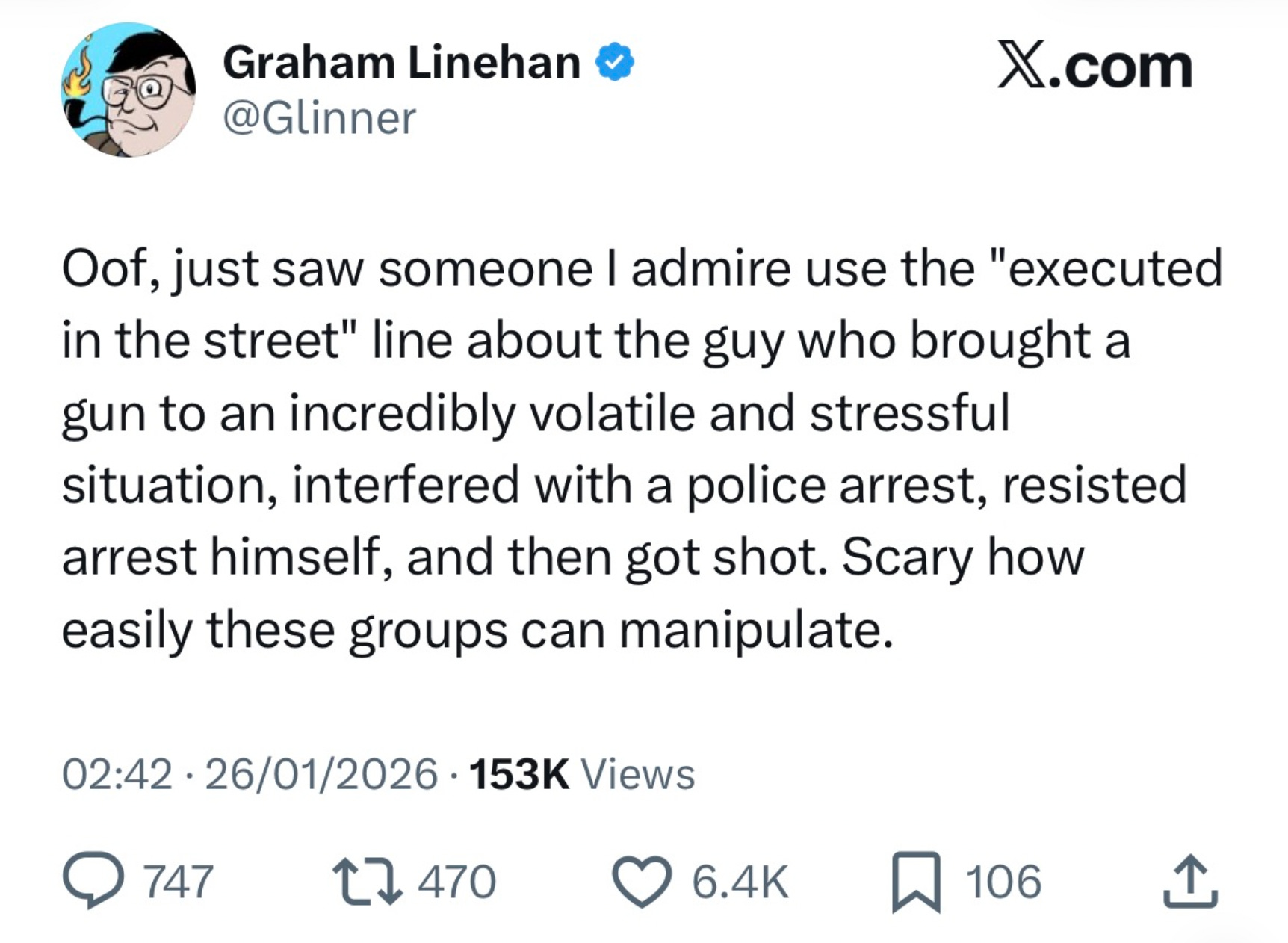
I have had my doubts about Linehan for some time. Not because he has not done plenty to highlight the excesses of gender woo-woo (he has and he has, as he will tell you at great length, suffered plenty for it).
No, the problem with Linehan is that it always has to be about Linehan. None of the women he saves are ever quite good enough for him. None, certainly, are ever as good as he is. They keep letting him down, chiefly by failing to note how much he has done for them and, forsooth, at a time when it was neither profitable nor popular to be doing such things. Thus he often has a pop at people such as Hadley Freeman and Helen Lewis (who was first writing about these things more than a decade ago!) who have each in some obscure way not done enough for him. Even JK Rowling does not escape his scorn. She too hasn’t given him sufficient recognition.
There is a strain of gender-critical thinking that can’t always be relied on to distinguish the wood from the trees. To this extent Linehan is now probably more useful to his political opponents - who wish to tar all gender critical campaigners with the Trumpist brush - than he is to the people with whom he is ostensibly allied.
Lesson: don’t spend too much time online.
Relatedly, like Jonathan Rauch I’ve long thought it pointless to spend too much time debating the question “Is Donald Trump a fascist?” because doing so advances little and risks, in any case, becoming bogged down in a tedious game of definitions. Nevertheless, he makes a plausible case that it’s now time to acknowledge reality.
Even if you accept the idea that Trump is too incoherent to be a true fascist, his administration undoubtedly contains people (Stephen Miller) who you might generously label fascist-adjacent and it continues to behave in ways that meet that standard too. This does not make all Trump’s voters fascists (though many of them are certainly fools) and it doesn’t, as Rauch correctly insists, make the United States a fascist country either.
But it does make it a country I have no intention of visiting while Trump and his goons remain in office. The sight of federal agents executing civilians on the streets of an American city is bad enough; to see so many people then excuse or celebrate this is somehow even worse. Enough is enough.
And finally… some GOOD NEWS
The Ocean Clean Up estimates it is now intercepting between two and five percent of ocean-going plastic pollution. It’s founder thinks it can double that this year, hoovering up plastic already in the sea and, crucially, intercepting it at river mouths before it can pollute the ocean. There is, clearly, a long way to go but this seems to prove that the concept is viable.
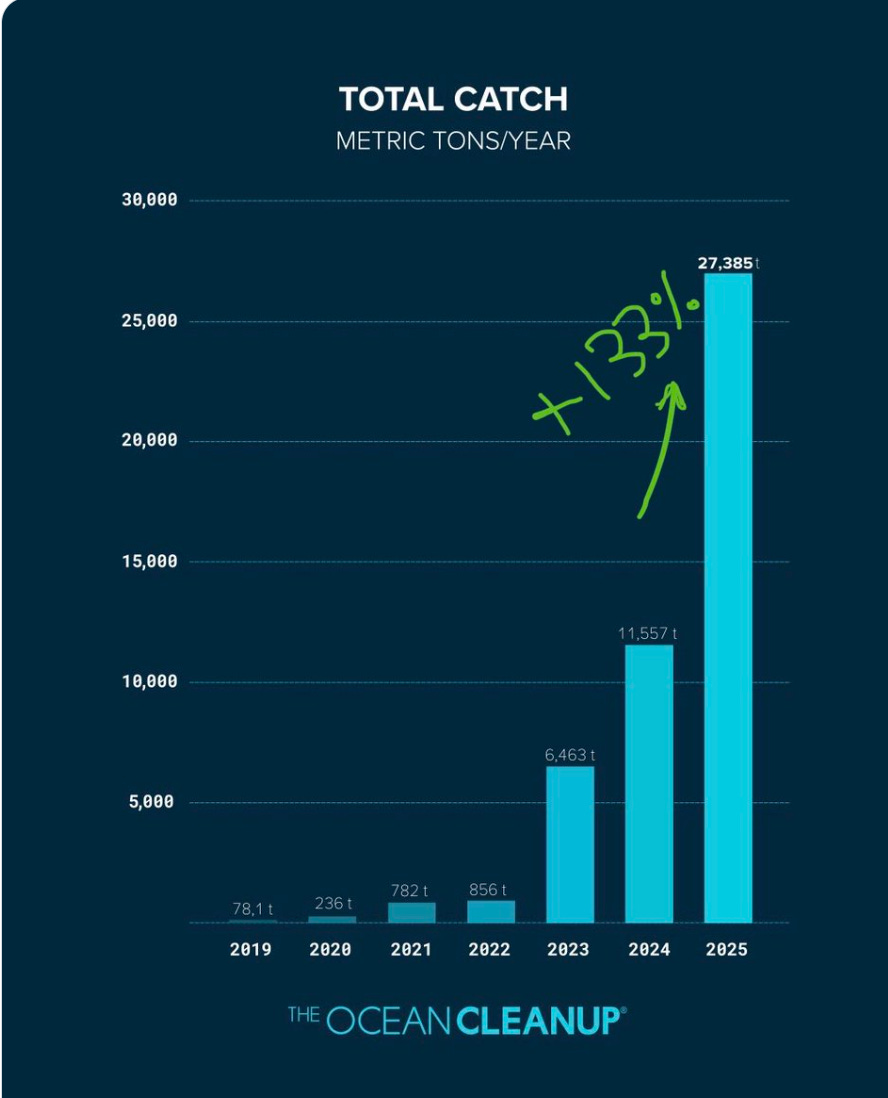
More broadly, it’s a reminder that human ingenuity is the solution to most of the problems we face today and that this is most especially true of environmental concerns. “We can invent our way out of this” risks seeming hopelessly Pollyannish but it has the general and important value of being true.
This newsletter goes out to more than ten thousand people. Thank you for subscribing. And I am especially grateful to those of you who have upgraded to a paid subscription. Your generosity makes this more feasible than would otherwise be the case. An annual subscription costs less than a Starbucks coffee a month; a monthly sub is less than a pint of lager…
If you can, please consider supporting The Debatable Land. Thank you.